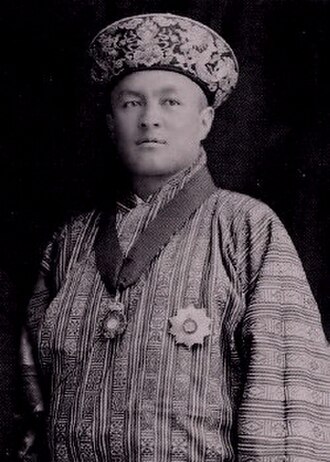
Second Druk Gyalpo · 1926–1952
Jigme Wangchuck
“Consolidator of the Realm”
- Born
- 1905 — Thinley Rabten Palace, Wangdue Phodrang
- Died
- 30 March 1952
- Reign
- 1926–1952
- Title
- Second Druk Gyalpo of Bhutan
Jigme Wangchuck (1905–1952) was the second Druk Gyalpo, or "Dragon King," of Bhutan, reigning from 26 August 1926 until his death on 30 March 1952. Born in 1905 at the Thinley Rabten Palace in the Wangdue Phodrang district, he was the only son of Ugyen Wangchuck, the founder of the hereditary monarchy established in 1907. Raised on a strict, traditional Buddhist education that was supplemented with proficiency in English and Hindi, he was groomed for kingship from an early age. He ascended the throne at the age of twenty-one upon his father's death in 1926 and received his formal coronation at Punakha on 14 March 1927, inheriting a unified but still fragile and feudally fragmented nation.
The defining achievement of Jigme Wangchuck's reign was the centralization and consolidation of the monarchy. Bhutan had long been a patchwork of regional fiefdoms in which real power was wielded by the penlops (provincial governors) and dzongpons (district administrators), who controlled their own territory, revenue, and private armies. Building on the foundation laid by his father, the King systematically curtailed the autonomy of these regional power-holders, abolished redundant sinecures, and bound all officials in direct loyalty to the throne. He established a simple hierarchical administration in which he exercised absolute authority over both secular and religious affairs, and he created a small cabinet or secretariat, the Nangi Lhengye Zhi, to assist in conducting the business of government. To formalize religious administration, he placed the monastic establishment under a centralized body headed by the Je Khenpo. This concentration of authority brought to an end the chronic internal rivalries and the threat of anarchy that had plagued Bhutan's history, transforming a loose confederation into a genuinely unified state ruled from the center.
Jigme Wangchuck also pursued significant administrative, fiscal, and judicial reforms. He restructured and rationalized the tax system, abolishing several burdensome levies and consolidating revenue collection under royal control rather than leaving it to the discretion of regional lords. In the realm of justice, he reduced judicial fees on ordinary citizens, discouraged the use of capital punishment for all crimes except murder, and notably allowed subjects to appeal the rulings of lower officials directly to the King himself. Alongside these governance reforms he invested in the physical and institutional fabric of the country, renovating dzongs and monasteries in eastern Bhutan, founding and restoring schools, and constructing royal residences such as the Kuenga Rabten winter palace in Trongsa and additional palaces at Samdrupcholing and Domkhar.
In foreign affairs, Jigme Wangchuck continued Bhutan's deliberate policy of near-total isolation, with its only external ties being to the British Raj, under whose 1910 Treaty of Punakha Bhutan was a protected state whose external relations Britain guided in exchange for non-interference in its internal affairs. During the Second World War, Bhutan maintained strict neutrality while remaining sympathetic to the British, and the King donated 100,000 rupees to the British war effort as a gesture of goodwill. When India gained independence in 1947 and the British withdrew from the subcontinent, Jigme Wangchuck moved decisively to secure Bhutan's position by sending a delegation to establish relations with the new Indian government. This culminated in the Indo-Bhutan Treaty of Friendship, signed on 8 August 1949, which revised the earlier Treaty of Punakha; under its terms India agreed not to interfere in Bhutan's internal affairs while Bhutan agreed to be "guided" by India in its external relations, India increased the annual subsidy paid to Bhutan, and 32 square miles of territory at Dewangiri were returned to Bhutan. The King died at the Kuenga Rabten Palace on 30 March 1952 and was cremated at Kurjey Lhakhang, leaving the throne to his son, Jigme Dorji Wangchuck, who became the third King and later earned the title "Father of Modern Bhutan."
Defining achievements
- Centralized and consolidated the monarchy, curtailing the autonomy of regional penlops and dzongpons and binding all officials in direct loyalty to the throne.
- Ended chronic feudal rivalries and the threat of internal anarchy, transforming a fragmented confederation into a unified, centrally governed state.
- Established a cabinet/secretariat (Nangi Lhengye Zhi) and a streamlined hierarchical administration under royal authority.
- Formalized religious administration by placing the monastic body under a centralized authority headed by the Je Khenpo.
- Restructured the tax system, abolished several burdensome levies, and brought revenue collection under royal control.
- Reformed the judiciary: reduced judicial fees, limited capital punishment, and permitted citizens to appeal lower officials’ rulings to the King.
- Negotiated the 1949 Indo-Bhutan Treaty of Friendship, securing Bhutan’s continued independence and recovering the Dewangiri territory after the British departure from India.