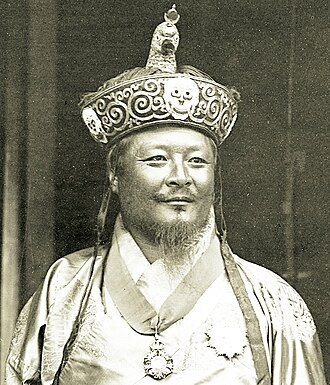
First Druk Gyalpo · 1907–1926
Ugyen Wangchuck
“Founder of the Dynasty”
- Born
- 11 June 1862 — Wangduecholing Palace, Bumthang
- Died
- 26 August 1926
- Reign
- 1907–1926
- Title
- First Druk Gyalpo of Bhutan
Ugyen Wangchuck (11 June 1862 – 26 August 1926) was the first Druk Gyalpo, or Dragon King, of Bhutan and the founder of the Wangchuck dynasty, which continues to rule the kingdom today. He was the son of Jigme Namgyal, the formidable Trongsa Penlop and "Black Regent" who had dominated Bhutanese politics until his death in 1881. Inheriting his father's ambition and military skill, Ugyen Wangchuck rose through a period of intense civil strife to become the most powerful figure in a country that had been fractured for centuries by the rivalries of competing regional governors, or penlops, under a weak and increasingly dysfunctional dual system of government.
Following his father's death, Ugyen Wangchuck fought to secure his inheritance, and by 1882 he had won control of the strategically vital governorship of Trongsa, the springboard of national power. His decisive moment came in 1885 at the Battle of Changlimithang, near Thimphu, where he led a force of roughly 2,400 troops — reinforced by his ally the Penlop of Paro — to victory over a rival coalition led by the Thimphu and Punakha dzongpons. This engagement is remembered as the last major civil conflict in Bhutanese history. It broke the back of organized opposition, subordinated the rival governors, and established Ugyen Wangchuck as the de facto ruler of the entire country, ending decades of fragmentation and laying the foundation for a unified nation-state.
Over the following two decades, Ugyen Wangchuck steadily dismantled the obsolete dual system of government, which had theoretically divided authority between the secular Druk Desi and the religious Shabdrung. After the last Shabdrung died in 1903 and no reincarnation was recognized, civil administration fell fully under his control. His standing was further enhanced abroad when he served as mediator between the British and the Tibetans during the 1903–1904 Younghusband expedition to Lhasa, for which the British knighted him (KCIE) in 1904. In November 1907 an assembly of monks, officials, and leading families convened to abolish the centuries-old dual system, and on 17 December 1907 Ugyen Wangchuck was unanimously elected and enthroned as Bhutan's first hereditary monarch at Punakha Dzong, with the British political officer Sir John Claude White present. That date is now celebrated as Bhutan's National Day.
As king, Ugyen Wangchuck cemented Bhutan's external security through the Treaty of Punakha, signed on 8 January 1910 with British India and represented on the British side by Charles Bell. The treaty doubled Britain's annual subsidy to Bhutan to 100,000 rupees and committed Bhutan to be guided by British advice in its external relations, while Britain pledged non-interference in Bhutan's internal administration — an arrangement that preserved the kingdom's domestic autonomy and shielded it from the colonial absorption suffered by neighboring Himalayan states. He maintained close and cordial relations with the British, who elevated his honors to Knight Grand Commander of the Order of the Indian Empire (GCIE) in 1921. By the time of his death on 26 August 1926, he had transformed Bhutan from a collection of warring fiefdoms into a stable, unified hereditary monarchy, and was peacefully succeeded by his son Jigme Wangchuck.
Defining achievements
- Founded the Wangchuck dynasty, Bhutan's ruling royal house since 1907.
- Unified Bhutan and ended centuries of civil war and regional fragmentation after his victory at the Battle of Changlimithang (1885).
- Abolished the dysfunctional dual system of government (Druk Desi and Shabdrung) and replaced it with a stable hereditary monarchy.
- Became the first Druk Gyalpo, enthroned on 17 December 1907 — now commemorated as Bhutan’s National Day.
- Negotiated the 1910 Treaty of Punakha, securing Bhutan’s autonomy and a peaceful relationship with British India while avoiding colonial absorption.
- Served as a trusted intermediary between Britain and Tibet during the 1903–1904 Younghusband expedition, earning British knighthood (KCIE, later GCIE).
- Established Bhutan’s first centralized, peaceful, and orderly succession, passing the throne to his son in 1926.