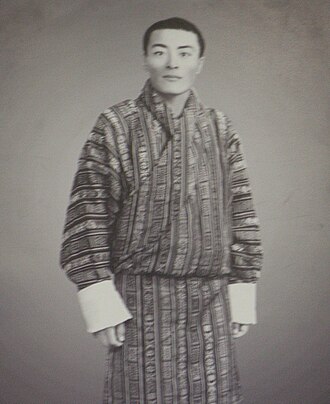
Third Druk Gyalpo · 1952–1972
Jigme Dorji Wangchuck
“Father of Modern Bhutan”
- Born
- 2 May 1928 — Thruepang Palace, Trongsa
- Died
- 21 July 1972 — Nairobi, Kenya
- Reign
- 1952–1972
- Title
- Third Druk Gyalpo of Bhutan
Jigme Dorji Wangchuck (1928–1972) was the third Druk Gyalpo, or Dragon King, of Bhutan, reigning from the death of his father in March 1952 until his own death in July 1972. Born on 2 May 1928 at Thruepang Palace in Trongsa, he was the son of the second king, Jigme Wangchuck, and Ashi Phuntsho Choden. Unusually for a Bhutanese royal of his generation, he received a partly Western education in Kalimpong and at institutions in India, supplemented by study tours to Britain and Switzerland, experiences that shaped his outward-looking vision. He succeeded to the throne on 30 March 1952 and was formally crowned at Punakha Dzong on 27 October 1952. He is universally remembered as the "Father of Modern Bhutan" for transforming a secluded, feudal, medieval kingdom into an emerging modern state with the foundations of representative government.
The defining theme of his reign was a deliberate, top-down program of social, political, and economic modernization. Among his earliest acts was the establishment in 1953 of the National Assembly, the Tshogdu, a consultative body of elected representatives, monastic officials, and royal nominees that marked the first major step toward constitutional monarchy. He dismantled Bhutan's entrenched feudal order: serfdom was progressively abolished from the mid-1950s (with reforms widely dated to 1956), and slavery was formally outlawed in 1958. Crucially, emancipation was paired with land reform — the king imposed ceilings on landholdings, redistributed a substantial share of arable land (estimated at around one-fifth) to the tillers who worked it, and granted former serfs and slaves citizenship and outright ownership of land, so that liberation came with the economic means to prosper. He also commissioned Bhutan's first written, codified legal framework, the Thrimzhung Chenmo (Supreme Law), enacted in the late 1950s, and separated the judiciary from the executive.
Jigme Dorji Wangchuck steadily devolved royal authority into durable institutions. He created the Royal Advisory Council (Lodoi Tshogde) in 1965 and a Council of Ministers (Lhengye Zhungtshog) in 1968, established the High Court (Thrimkhang Gongma) in 1968, and founded the Royal Bhutan Army in 1963. In a remarkable act of self-limitation, in November 1968 he vested sovereign legislative power in the National Assembly — including, in principle, the power to remove ministers and even to compel the abdication of the king through votes of confidence — thereby voluntarily constraining the absolute monarchy he had inherited. Economic modernization was organized through centralized planning: the First Five-Year Plan (1961–1966), funded almost entirely by India, prioritized roads, schools, and health facilities, and was followed by the Second Five-Year Plan (1966–1971). His reign saw the country opened by more than 1,200 km of new roads, the first motorable link to Thimphu, the establishment of schools and hospitals, a national currency and postal system, and the relocation of the year-round capital to Thimphu.
In foreign affairs, the king operated within the framework of the 1949 Treaty of Friendship with India, signed at Darjeeling on 8 August 1949 shortly before his accession, under which Bhutan agreed to be "guided by" India's advice in external relations while India undertook not to interfere in Bhutan's internal administration. China's 1950 annexation of Tibet and the 1959 flight of the Dalai Lama heightened Bhutan's security concerns and deepened its reliance on Indian aid for development. Determined to secure Bhutan's sovereignty through international recognition, the king led the country into the Colombo Plan in 1962, the Universal Postal Union, and, after a period as an observer, full membership of the United Nations in 1971, when Bhutan became the organization's 125th member. He died of heart failure in Nairobi, Kenya, on 21 July 1972 at the age of 44, and was succeeded by his son Jigme Singye Wangchuck. His body was cremated at Kurjey Lhakhang in Bumthang.
Defining achievements
- Abolished serfdom (from c. 1956) and formally abolished slavery (1958), ending Bhutan’s feudal bonded-labour system.
- Carried out land reform with landholding ceilings, redistributing roughly one-fifth of arable land to tillers and granting former serfs and slaves citizenship and outright land ownership.
- Established the National Assembly (Tshogdu) in 1953, Bhutan’s first legislature and the first major step toward constitutional monarchy.
- Voluntarily devolved royal power, vesting sovereign legislative authority in the National Assembly in 1968, including provision for votes of confidence in the king.
- Created the Royal Advisory Council (1965), Council of Ministers (1968), and High Court (1968), institutionalizing separate branches of government.
- Promulgated the Thrimzhung Chenmo, Bhutan’s first written, codified legal code, and separated the judiciary from the executive.
- Built more than 1,200 km of roads, a national currency, a postal system, schools and hospitals, and moved the year-round capital to Thimphu.
- Secured international recognition of Bhutan’s sovereignty by joining the Colombo Plan (1962) and the United Nations (1971).