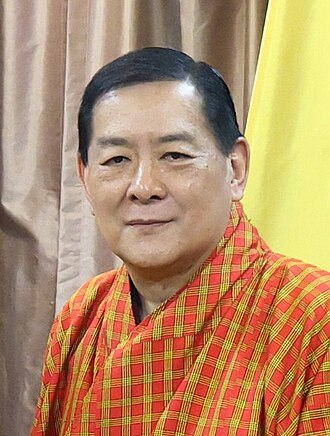
Fourth Druk Gyalpo · 1972–2006
Jigme Singye Wangchuck
“Father of Gross National Happiness”
- Born
- 11 November 1955 — Dechencholing Palace, Thimphu
- Reign
- 1972–2006
- Title
- Fourth Druk Gyalpo of Bhutan
Jigme Singye Wangchuck, the fourth Druk Gyalpo (Dragon King) of Bhutan, was born on 11 November 1955 at Dechencholing Palace in Thimphu, the only son of the third king, Jigme Dorji Wangchuck. Educated in Bhutan, India, and at boarding schools in the United Kingdom, he was named Crown Prince and Penlop (governor) of Trongsa in 1972. When his father died suddenly in Nairobi, Kenya, on 21 July 1972, the sixteen-year-old prince ascended the throne, becoming at that time the world's youngest reigning monarch. His formal coronation was held nearly two years later, on 2 June 1974, in a grand ceremony in Thimphu that drew international attention to the small Himalayan kingdom for the first time.
The defining idea of his reign was Gross National Happiness (GNH), a development philosophy holding that the true measure of a nation's progress lies in the well-being and contentment of its people rather than in purely economic output. The young king is credited with articulating the concept early in his reign, and the now-famous formulation entered the public record in 1979, when he reportedly told journalists that "Gross National Happiness is more important than Gross National Product." Drawing on a value embedded in Bhutan's seventeenth-century legal tradition — that government exists to create happiness for its people — he framed GNH around what became its four pillars: sustainable and equitable socio-economic development, environmental conservation, preservation and promotion of culture, and good governance. The idea has since influenced global discussions on well-being, sustainability, and alternative measures of national progress.
A central theme of his thirty-four-year reign was modernization carefully balanced against cultural and environmental preservation. Under his rule Bhutan expanded health services, roads, schools, and electricity while remaining one of the most cautious countries in the world about the pace of change; television and the internet, for example, were only permitted in 1999. He championed environmental protection — Bhutan committed to keeping a large majority of its territory under forest cover and established an extensive network of national parks — and supported the revival of traditional arts, architecture, dress, and Buddhist monastic institutions. Health and education indicators improved dramatically during his reign, with life expectancy rising from roughly 40 years in the early 1970s to the mid-60s by 2006.
Perhaps his most remarkable legacy was the voluntary surrender of power. Convinced that the security of the nation should not rest on any single individual, and that the best time to reform was during peace and stability, he steadily devolved authority — introducing district development committees, decentralizing decision-making, and in 1998 transferring executive powers to an elected Council of Ministers. He initiated the drafting of Bhutan's first written constitution in 2001, paving the way for a democratic constitutional monarchy. On 9 December 2006, ahead of the planned 2008 elections, he abdicated in favour of his eldest son, Jigme Khesar Namgyel Wangchuck, who became the fifth king. The transition culminated in the adoption of the Constitution in 2008 and Bhutan's first democratic elections. He is widely revered in Bhutan as the architect of its modern statehood and its peaceful path to democracy.
Defining achievements
- Conceived and articulated Gross National Happiness (GNH), an internationally influential development philosophy prioritizing well-being over economic output, structured around four pillars.
- Modernized Bhutan — greatly expanding healthcare, education, roads, and electricity — while deliberately balancing development against cultural and environmental preservation; life expectancy rose from about 40 to the mid-60s during his reign.
- Pioneered environmental conservation as state policy, committing Bhutan to extensive forest cover and an expanded network of national parks and protected areas.
- Voluntarily led Bhutan’s transition from absolute monarchy to democratic constitutional monarchy, transferring executive authority to an elected cabinet in 1998 and ordering the Constitution’s drafting in 2001.
- Abdicated voluntarily in December 2006 in favour of his son to ensure a smooth, peaceful democratic transition rather than clinging to power.
- Internationally recognized for environmental and well-being leadership, including the J. Paul Getty Award for Conservation Leadership (2006) and the Blue Planet Prize (2022).