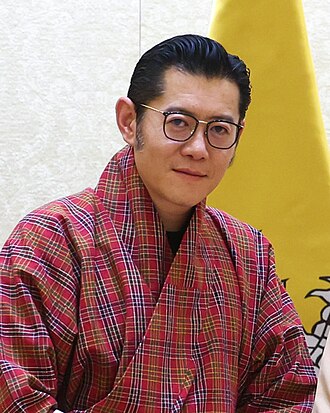
Fifth Druk Gyalpo · 2006–present
Jigme Khesar Namgyel Wangchuck
“The People’s King”
- Born
- 21 February 1980 — Kathmandu, Nepal
- Reign
- 2006–present
- Title
- Fifth & current Druk Gyalpo of Bhutan
Jigme Khesar Namgyel Wangchuck is the fifth and current Druk Gyalpo (Dragon King) of Bhutan, having reigned since December 2006. Born on 21 February 1980 in Kathmandu, Nepal, he is the eldest son of the fourth king, Jigme Singye Wangchuck, and Queen Tshering Yangdon. He received his early schooling in Bhutan before studying in the United States at Phillips Academy Andover and Cushing Academy in Massachusetts, and then earning a degree from Wheaton College. He completed his higher education at Magdalen College, University of Oxford, where he undertook the Foreign Service Programme and an MPhil in Politics. Widely known as the "People's King," he is celebrated in Bhutan for his accessibility and his deep personal engagement with ordinary citizens.
He came to the throne when his father abdicated in his favour in December 2006, becoming, at the age of 26, the youngest reigning monarch in the world at the time. His formal coronation took place on 6 November 2008 in the capital, deliberately timed to coincide with the centenary of the Wangchuck dynasty, which had been founded in 1907. Far from consolidating royal power, the young king presided over the deliberate and voluntary dismantling of Bhutan's absolute monarchy. As crown prince and king he travelled extensively across the country between 2005 and 2008 to explain the draft constitution to citizens in person and gather their feedback, championing his father's vision of transforming Bhutan into a democratic constitutional monarchy.
That transition reached its culmination during his early reign. Bhutan held its first National Assembly elections on 24 March 2008, producing the country's first democratically elected government and first elected prime minister, Jigme Y. Thinley. On 18 July 2008 the Constitution of the Kingdom of Bhutan was formally adopted, establishing a parliamentary democracy with a separation of powers, guaranteed fundamental rights, and a constitutional monarch whose sovereign authority derives from the people. The peaceful, top-down handover of power from crown to ballot box, widely judged free and fair by international observers, is regarded as one of the most remarkable democratic transitions of the modern era.
On 13 October 2011 the king married Jetsun Pema, the daughter of a pilot, in a traditional Buddhist ceremony at the historic Punakha Dzong; she became queen at the age of 21. The couple have three children: Crown Prince (Gyalsey) Jigme Namgyel Wangchuck, born 5 February 2016; Prince Jigme Ugyen Wangchuck, born 19 March 2020; and Princess Sonam Yangden Wangchuck, born 9 September 2023. Beyond the constitutional settlement, his reign has been marked by ambitious nation-building initiatives. In December 2019 he announced Gyalsung, a compulsory one-year national service for Bhutanese citizens turning eighteen, whose first cohort began in 2024. In December 2023 he unveiled the Gelephu Mindfulness City, a vast special administrative region on the Indian border intended to diversify Bhutan's economy while embedding the nation's Gross National Happiness philosophy, Buddhist spirituality, and environmental values into a new model of sustainable urban development.
Defining achievements
- Oversaw Bhutan's peaceful transition from absolute monarchy to a democratic constitutional monarchy, including the country's first parliamentary elections in March 2008.
- Presided over the adoption of the Constitution of the Kingdom of Bhutan on 18 July 2008, voluntarily ceding executive power to an elected government.
- Crowned fifth Druk Gyalpo on 6 November 2008, on the centenary of the Wangchuck dynasty.
- Earned a lasting reputation as the 'People's King' for his accessibility and direct engagement with citizens across the country.
- Launched Gyalsung, a national service programme combining training and vocational education for all 18-year-old citizens, with the first cohort beginning in 2024.
- Conceived and announced the Gelephu Mindfulness City (2023), a special administrative region designed to diversify Bhutan’s economy while embedding Gross National Happiness principles.